
A friend scored 0/7 on the Ur-Leica Challenge. Read the story — then try to beat them.
Take the challenge →From the journal · Leica history · Wetzlar 1914
42 · Mikro-Summar · 1/40 · f/4.5
The Ur-Leica. The camera that invented 35mm.
How an asthmatic engineer, a film-testing gadget and one brave “yes” from Ernst Leitz II gave us the Leica — and the 24×36 frame we still shoot today.

Picture Wetzlar, a hilly little town on the River Lahn, in about 1913. Photography means a wooden camera, a tripod, a case of glass plates and a strong back. Oskar Barnack, a master mechanic at the optical firm Ernst Leitz, had the eye of a photographer but not the lungs for it: he suffered from severe asthma, and hauling that kit up Wetzlar’s hills was exhausting. So he did what great engineers do. He built something smaller.
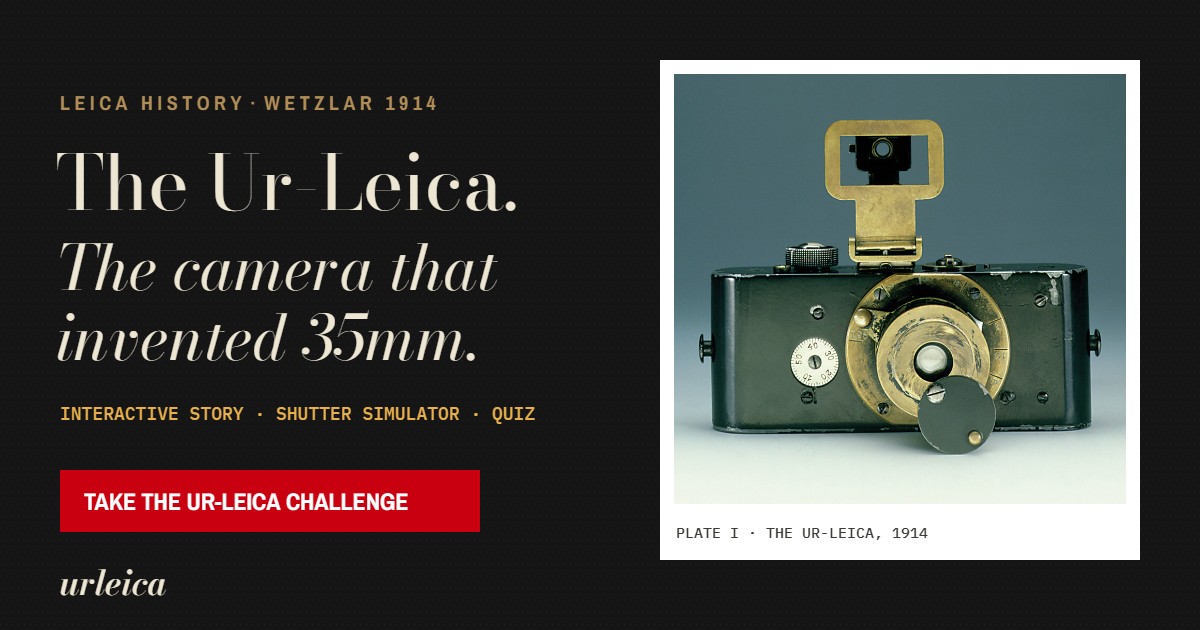
The result was a palm-sized metal box that its maker called the Liliput. Collectors later gave it the name we use today: the Ur-Leica — “ur” being German for original. It is the ancestor of every Leica ever made, and arguably of every 35mm camera in the world.
The man from Lynow
Oskar Barnack was born on 1 November 1879 in Lynow, Brandenburg. He trained as a mechanic and worked as a precision engineer at Carl Zeiss in Jena before joining Ernst Leitz in Wetzlar in 1911, where he soon headed development work.
As early as 1905 he was toying with the idea of small negatives that could be enlarged later. What finally turned that idea into metal was a very practical problem on his workbench.

A film-tester that became a camera
Around 1912 Barnack was developing a 35mm cinema camera for Leitz. Cine film emulsions of the day varied from batch to batch, and a wrong guess could waste an entire long spool. So he built a little tester that exposed just a few frames, to find out how a roll behaved before committing the rest of it.
Then came the leap. Cinema film runs vertically through a movie camera, giving a small 18×24mm frame. Barnack turned the film on its side and ran it horizontally, doubling the frame to 24×36mm. That single decision created the “full frame” format that photographers still talk about over a century later. Try it yourself:
Anatomy of a legend
The Ur-Leica is a mechanical masterpiece of minimalism. Tap the brass points to explore.

The first Leica photograph
In 1914 Barnack stepped out into Wetzlar’s old town and photographed shoppers in front of the Eisenmarkt — the iron market. It is regarded as the first picture ever taken with a Leica. Today a manhole cover on that very spot carries an engraving of the Ur-Leica and an inscription marking where the first Leica picture was taken. Every Leica pilgrim to Wetzlar should stand on it once.

That same year, company boss Ernst Leitz II took a prototype with him on a business trip by ship to New York. He wasn’t a photographer — which made the trip the perfect test. His pictures from the journey include what we would now call early street photography, and his experience with the little camera would shape its fate a decade later.
Shoot like Barnack, 1914
The Ur-Leica gave you a fixed lens and just two shutter speeds: 1/20 or 1/40. And there was a catch — its shutter had a fixed slit, so winding it on would sweep that open slit across the film. The trick was to put the lens cap on before winding. Pick your light, follow the ritual, and see how you do.

War, a flood, and a bold decision
World War I stopped everything. The camera sat on the shelf for years — though Barnack kept shooting. In 1920 he documented the great flood of Wetzlar with his little camera, proving it could do real reportage in real conditions.

In 1923 Barnack persuaded Leitz to build a small pre-production batch — the famous 0-Series (Null-Serie), 31 cameras with serial numbers in the 100s, sent out to photographers for testing. The feedback was mixed and Germany was in the grip of hyperinflation. Many inside the company thought it was too risky. Ernst Leitz II listened, and then decided:
In 1925 the Leica I — Leitz Camera — was presented at the Leipzig Spring Fair. It kept the Ur-Leica’s 24×36 frame and pocketable body, but gained a proper 50mm f/3.5 lens designed by Leitz’s optical genius Max Berek, first called the Leitz Anastigmat and soon renamed Elmax. The 35mm revolution had begun.
From idea to icon
Priceless — and very nearly priced
The Ur-Leica itself is not for sale. Barnack built three versions: the first and third survive at Leica in Wetzlar, while the second is lost. But its closest relatives, the 0-Series cameras, have become the most valuable cameras on earth. Only about a dozen are known to survive.
No. 105 — once owned by Oskar Barnack himself — sold for €14.4 million including premium in June 2022, the world record for any camera. For the rest of us, Leica produced Ur-Leica replicas from the 1970s onwards, engraved “Nachbildung der Ur-Leica” on the top plate. Working replicas are sought-after collector pieces in their own right.

Think you know your Leica? Prove it.
Answer seven questions, get your personal Ur-Leica certificate, and challenge your camera friends to beat your score.
Know a Leica nut? Send them this.
Every Leica owner has a friend who still shoots film, a cousin with grandpa’s camera in the cupboard, or a group chat full of rangefinder talk. One tap sends them the story.
Your camera WhatsApp group
Drop it into the group with a ready-made message. Perfect conversation starter.
Facebook and Reddit communities
In the Facebook dialog choose “Share to a group” to post it straight into your Leica or film-photography groups.
Friends in your address book
Pick people straight from your phone’s contacts, or send a personal email or text message.
Every Leica carries Barnack’s DNA
From a Leica I or a screw-mount Leica III to an M3 or M6, the line runs straight back to that little box in Wetzlar. If you have a Leica, Leitz lens or other vintage camera in a cupboard, we’d love to see it. Free, no-obligation valuations across South Africa — cash paid.
Sources & image credits
- Leica Camera AG — Leica timeline, 1914; 0-Series No. 112 sale
- International Photography Hall of Fame — Oskar Barnack
- Apotelyt — Leitz Ur-Leica
- Mike Eckman — Oskar Barnack’s first Leica
- University of Wuppertal — The first 35mm camera
- Phototrend — Leica 0-Series No. 105, €14.4 million
- Kosmo Foto — The first picture taken on a Leica
- Images via Wikimedia Commons: Ur-Leica (header) © Leica Camera, CC BY-SA 2.0 DE; replicas by Rama, CC BY-SA 2.0 FR; Barnack portrait and Barnack’s 1914/1920 photographs, public domain.
Share the story
Send it to a Leica friend, your camera group or your contacts.
Tip: on Facebook, pick “Share to a group” to post it into your Leica groups.